
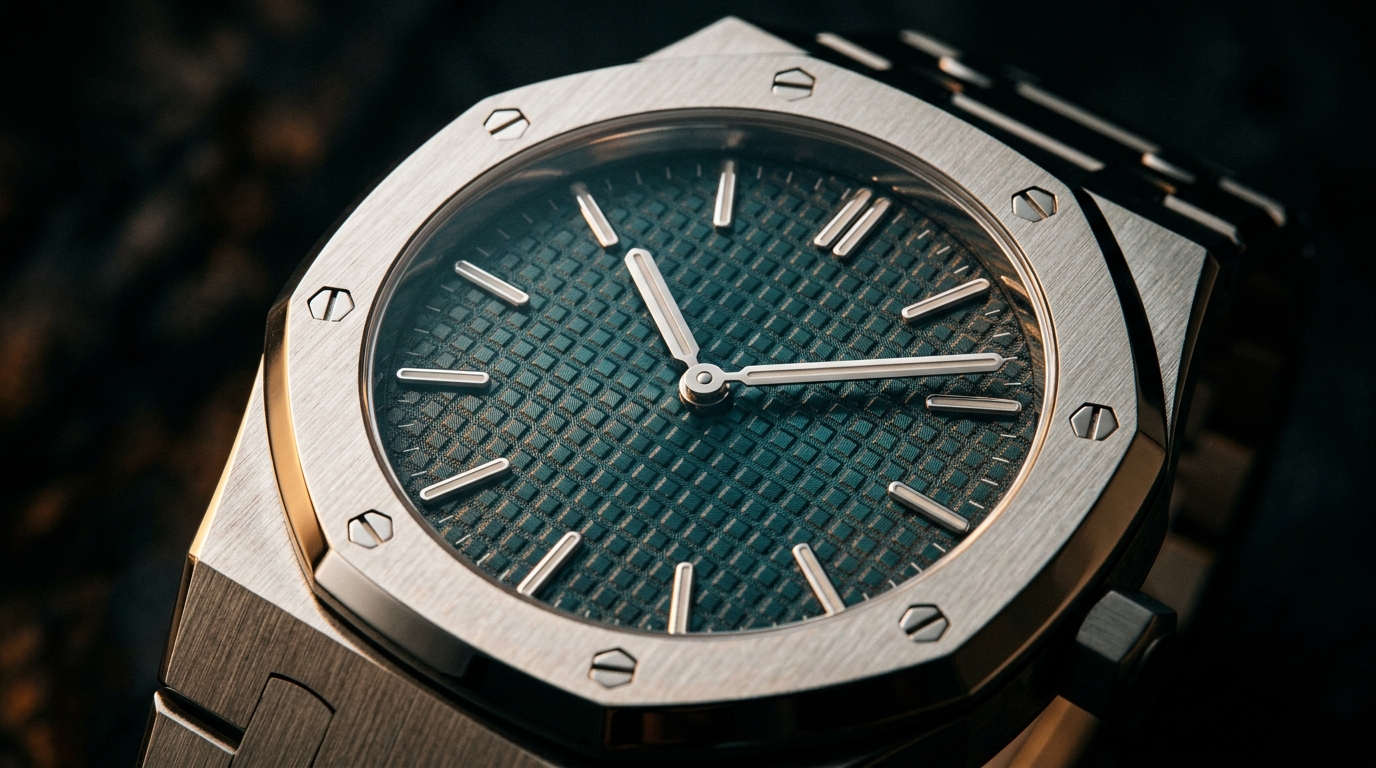
A Royal Oak's resale value is not set by its reference number alone. Two examples of the same reference — same year, same material, same nominal configuration — can trade at a meaningful spread once condition, dial variant, service history, completeness and provenance are read carefully. This guide sets out the value drivers a serious buyer weighs before making an offer, with sourced July 2026 examples where reliable public data supports them, and a working appraisal-adjustment framework that a reader can apply to a specific candidate.
Data references reflect publicly available Audemars Piguet material and the last twelve months of major auction results at Christie's, Sotheby's and Phillips, cross-checked against established secondary-market platforms. Observations are stated as of July 21, 2026. Auction figures are the premium-inclusive total unless otherwise labelled; secondary-platform figures are current asking prices, not completed sales, and are treated accordingly.
The Nine Value Drivers, Ranked by Typical Impact
- Reference and generation. Determines architectural family and market plane.
- Material (suffix). ST, OR, BA, BC, PT, CE — can move value by an order of magnitude.
- Dial variant and tone. Bleu Nuit, black, silver, grey, salmon and anniversary configurations price differently.
- Case condition and case originality. Chamfer sharpness is the single most reliable in-hand originality tell.
- Bracelet condition. Stretch, clasp code, endlink fit.
- Dial originality. Original vs. service dial; period-correct hands and luminous material.
- Completeness. Warranty card / Certificate, invoice, service records, box, hangtags.
- Provenance. Fresh to market, single owner, catalogued prior sales.
- Anniversary or limited status. Documented limited series, anniversary configurations.
Reference and Generation — the Base Coordinates
A useful working periodisation groups the core Royal Oak time-and-date line into four generations — founding (5402), transitional (14790, 14802, 15002), modern Jumbo era (15202, 15300, 15400, 15500) and 50th-anniversary and beyond (16202, 15510). The generation frames the market plane. The 15202ST — discontinued in 2022 — sits on a different plane than a comparable 15400ST from the 2012–2019 run. Both are steel Royal Oaks; they are not comparable examples.
Material and Suffix — Reading the Price Multiplier
Suffix notation determines material. On any given reference, a rough ordering of material planes at retail is ST < BA < OR < BC < PT, with CE (ceramic) priced above steel and typically between the gold configurations. Secondary-market planes are less orderly than retail planes: steel benefits from allocation-driven premiums, while precious-metal configurations sometimes trade at wider discounts to retail because retail supply is less constrained.
Dial Variants and Tone — the Fine Adjustment
Two 16202ST examples with different dial tones can trade meaningfully apart. Bleu Nuit "Nuage 50" has been the modern signature; certain anniversary configurations and small-run coloured dials (green, salmon, smoked variants) command distinct premiums. Grande vs. petite tapisserie also matters, since it distinguishes generation lines within the family. A dial's tone should be read against the reference's design intent, not on its own.
Case, Bracelet, Dial Condition — the Sharpest Discount Axis
A polished Royal Oak is not a broken watch; it is a Royal Oak that has been moved away from its factory geometry. On modern references the effect is measurable but recoverable through careful service work; on vintage references, a heavy polish can subtract 30–50% from the fair-value ceiling. Bracelet stretch, mismatched endlink fit, and clasp codes inconsistent with the reference period are all additional discount signals. Original dial with period-correct luminous material anchors the top of the range; a service dial is a legitimate maintenance outcome that discloses openly and prices at a discount.
Completeness and Provenance — the Friction Adjustment
Complete factory documentation on a modern Royal Oak — Certificate of Origin, original invoice, hangtags, box, outer box, service records — reduces the friction of the next sale. That friction reduction is what the market prices, and it is often larger than the sentimental value of the paperwork. A missing warranty card on a sought-after modern reference is typically a mid-single-digit to low double-digit discount; on a vintage reference, complete original documentation is rarer and, when present, adds a premium rather than its absence producing a discount.
An Appraisal-Adjustment Framework
A defensible fair-value estimate for a specific Royal Oak candidate is built by anchoring on a written comparable-market range and applying signed adjustments for the specific example. The framework:
| Adjustment | Direction | Typical Range |
|---|---|---|
| Anniversary / limited variant of same reference | Premium | +10% to +50%+ |
| Discontinued and non-replaced configuration | Premium | +5% to +25% |
| Unpolished case, original dial, correct hands | Premium | +5% to +20% |
| Full set with recent factory service | Premium | +3% to +10% |
| Documented notable ownership | Premium | Variable; potentially transformational |
| Missing warranty card (modern reference) | Discount | −5% to −15% |
| Heavy polish, softened chamfers | Discount | −10% to −40% |
| Service dial (vintage reference) | Discount | −15% to −35% |
| Aftermarket parts (dial, hands, bezel) | Discount | Material; often disqualifying at the top of the market |
Ranges are directional and should be applied to a specific market anchor, not to each other. On any single watch, several adjustments apply simultaneously and the net effect is written in the file, not multiplied blindly.
Historical Appreciation — Without Cherry-Picking
The discontinued 15202ST is the reference most commonly cited as an appreciation story. Public auction data at Christie's, Sotheby's and Phillips through 2020–2022 showed premium-inclusive totals well above retail, followed by a partial compression in the 2023–2024 correction and a stabilisation into 2025–2026. A careful reader notes three things about that record. First, it applies to the specific 15202ST and does not automatically extend to the successor 16202ST. Second, the 2020–2022 peak reflected an extraordinary cycle in luxury watches overall; benchmarking against that peak overstates a rational hold-to-realise expectation. Third, individual examples have varied widely by condition and completeness within any window.
The Royal Oak Chronograph 26240 lineage, the earlier 26320 chronograph, and select anniversary configurations have shown durable secondary demand. Modern 41 mm selfwinding references (15400, 15500, 15510) have followed a more conventional pre-owned pattern, with strong retention on unpolished full-set examples and material discounts on tired ones. Precious-metal Royal Oak configurations historically trade at wider discounts to retail than steel, with exceptions on specific anniversary and small-run releases.
Condition Red-Flag Checklist
- Chamfer softness or rounded case edges under a loupe.
- Alternating brushed/polished surfaces blurred or run together.
- Case flanks with visible refinishing lines.
- Bracelet with material stretch on tapered links.
- Endlink fit inconsistent with the reference period.
- Clasp code that does not correspond to the case production year.
- Dial with luminous compound whose age or tone does not match the hands.
- Dial signature font or spacing inconsistent with the reference.
- Movement with service parts not disclosed in the file.
- Warranty card serial not matching the case serial.
- Invoice dated outside the reference's production window.
- Prior auction record referencing a different configuration or condition.
Editorial Callout
A written comparable-market file, honest adjustments applied in the open, and an unpolished full-set example bought near — not at the top of — the asking-price distribution: the combination is the closest thing to a repeatable process in a market that offers no repeatable outcomes.
Condition Adjustment — Worked Examples
Condition on a Royal Oak is priced against a specific reference-appropriate ideal, not a generic "used" baseline. A 15202ST offered as "unpolished" but showing rounded bevels on the case shoulder is not unpolished; the correct adjustment is the delta between an unpolished honest-wear comparable and a lightly-refinished comparable of the same configuration, typically a meaningful discount rather than a token one because the tapisserie-era jumbo market pays specifically for factory geometry. A 15400ST with visible bracelet stretch — links that fall open under their own weight, a clasp that closes with audible play — should be adjusted by the cost of a full AP bracelet service plus a residual discount for the buyer's future re-service, since the stretch signals wear pattern rather than a single incident. A 26331ST chronograph with a service dial (identifiable by lume tone, printing thickness or a change in sub-dial ring) is a different asset than the same reference with an original dial; the adjustment is not cosmetic but collectible, and the correct comparable set is other service-dial prints, not original-dial prints. Each of these adjustments should be written down in the appraisal, with a comparable citation, so the buyer and seller are negotiating against the same evidence.
Configuration Liquidity
Two Royal Oaks with the same headline value can have very different liquidity, and liquidity is itself a price factor because it determines exit cost. Core references in stainless steel with common dial colours — 15400ST blue, 15500ST black, 26331ST silver — clear quickly across private and platform channels, so the ask-to-executed spread is narrow and the appraisal can rely on a deep comparable set. Precious-metal, coloured-dial or limited-configuration pieces (yellow-gold jumbos, salmon dials, "Frosted Gold" variants, small-series collaborations) clear more slowly and often only to a specific collector; comparable data is thinner and each print carries more information. When appraising the second category, widen the fair-value band to reflect that a single willing buyer sets the price, budget more time to sale on the seller side, and price the buyer side against the second-strongest comparable rather than the peak print. Liquidity is not a moral judgement on the reference — some of the strongest Royal Oaks are illiquid — but it is a real, quantifiable cost that belongs in the adjustment.
Where Timepiece Opulence LSP Fits
Timepiece Opulence LSP provides comparable-market research and private-channel access on Royal Oak acquisitions. Our practice is to build a written comparable-market file for the exact reference, configuration and condition under review, apply the adjustment framework above in writing, and route the candidate through independent third-party physical authentication before placement. We do not represent that any specific Royal Oak reference will appreciate.
Continue Reading
For a reference-level walk through the Royal Oak family, see the Royal Oak reference guide. For a generations, materials and dial matrix, see Royal Oak Generations, Dials and Materials Explained. For an off-market acquisition framework, see How to Buy an Audemars Piguet Royal Oak Off-Market.
Sources
- Audemars Piguet Royal Oak collection — audemarspiguet.com.
- Auction archives at christies.com, sothebys.com, phillips.com.
- Secondary-market asking-price data at watchcharts.com.
Editorial disclosure and risk notice. Timepiece Opulence LSP is an independent private brokerage. We are not affiliated with, endorsed by, or an authorized dealer of Audemars Piguet. Observations reflect publicly available sources as of July 21, 2026. Past performance is not a guarantee of future returns; watches carry service, insurance and market risk and should not be treated as a substitute for regulated investment products.