
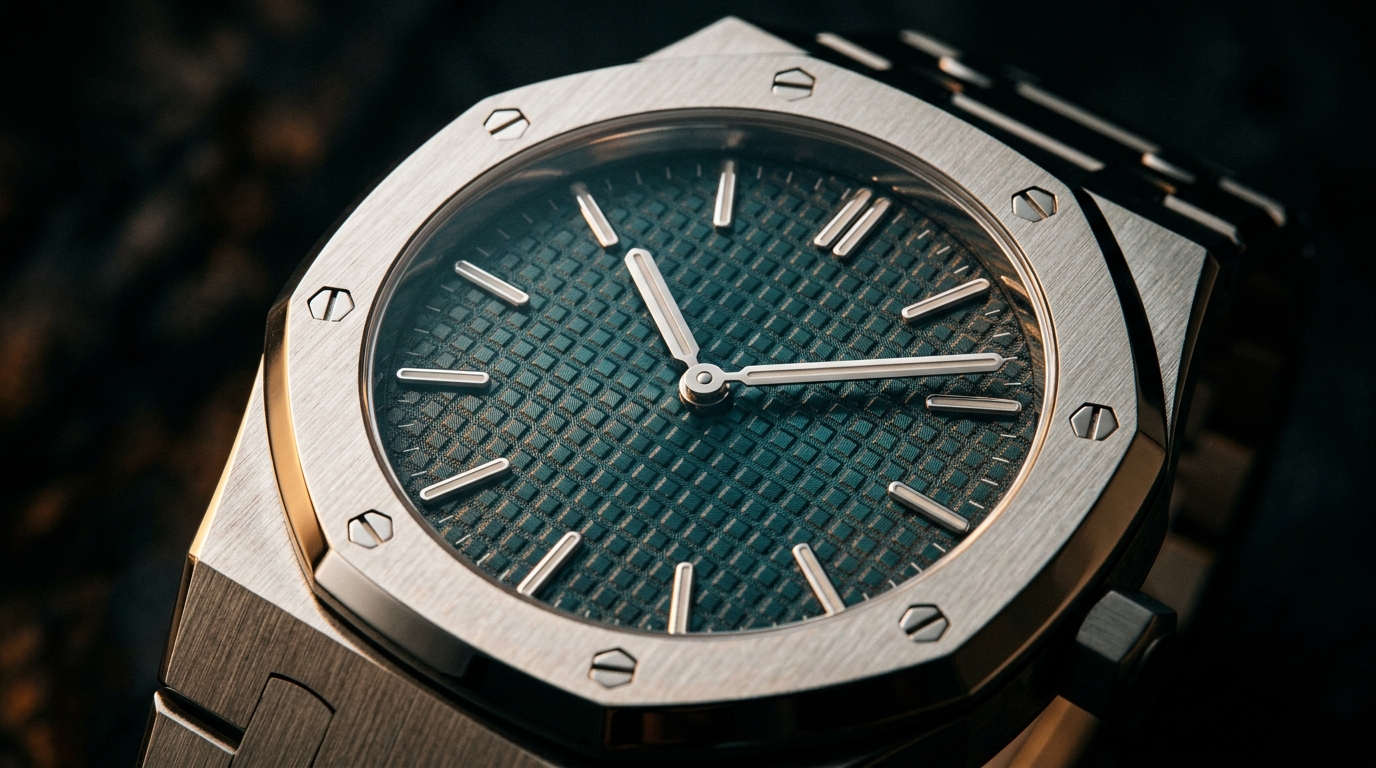
The Royal Oak family is easier to understand as a matrix than as a ranked list of icons. Four generations of case architecture, four core complication buckets, five materials and a decades-long evolution of the tapisserie dial produce a catalogue in which two references separated by a single suffix character can differ materially in value. This guide organises the Royal Oak by generation, size, material and complication — with a working framework for reading why one reference is worth what another is not.
Observations reflect publicly available Audemars Piguet material and major auction records as of July 21, 2026.
Royal Oak Generations at a Glance
A useful working periodisation of the core Royal Oak time-and-date line groups the references into four generations:
| Generation | Window | Representative Refs | Marker |
|---|---|---|---|
| Founding (Genta era) | 1972–late 1980s | 5402ST | Extra-thin caliber 2121; petite tapisserie. |
| Mid / transitional | 1992–2000 | 14790, 14802, 15002 | 36 mm mainstream; 20th Anniversary Jumbo revival. |
| Modern Jumbo era | 2000–2022 | 15202, 15300, 15400, 15500 | Permanent Jumbo Extra-Thin; 41 mm selfwinding line. |
| 50th Anniversary and beyond | 2022–present | 16202, 15510 | Caliber 7121; refined dial and case architecture. |
Sizes — the Two Core Diameters
The core Royal Oak time-and-date line has settled around two diameters: 39 mm (the Jumbo Extra-Thin lineage, from 5402 through 15202 to 16202) and 41 mm (the selfwinding date line, from 15300 through 15400, 15500 and 15510). A 37 mm case exists in the modern catalogue for contemporary "unisex" and ladies' configurations. Historical 36 mm and mid-size references remain a distinct sub-market.
Case thickness is often more meaningful than diameter. The Jumbo Extra-Thin sits at approximately 8.1 mm; the selfwinding 41 mm at approximately 10.4 mm. The thinner case is a defining Genta-era architectural choice, and the market prices it accordingly.
Materials — Steel, Gold, Platinum, and the Modern Alternatives
- Stainless steel. The material Genta chose for the founding Royal Oak. Steel references dominate the modern secondary market for both Jumbo and 41 mm lines and carry the most persistent allocation pressure at retail.
- Yellow gold. Present since the founding era; understated compared with contemporaries. Recent yellow-gold Royal Oak configurations have been a quiet collector interest.
- Pink / rose gold. Introduced later; the current 16202OR and equivalents.
- White gold. A durable configuration positioned as an alternative to platinum.
- Platinum. Reserved for anniversary and limited releases; heavy, rare, priced accordingly at retail and at auction.
- Ceramic and titanium. Available principally in complication references (Royal Oak Perpetual Calendar, Chronograph) and select limited time and date variants. Fabrication of the alternating brushed/polished ceramic case is materially more complex than steel and reflected in retail pricing.
Tapisserie Dial Scales and Tones
The tapisserie pattern that carries the Royal Oak's visual identity is not a single texture. Three scales matter to a serious reader:
- Petite tapisserie. The founding-era pattern; smallest cells, retained on the Jumbo Extra-Thin line through the 15202 and, in a refined form, on the 16202.
- Grande tapisserie. Larger cells; the pattern deployed on the 15300, 15400 and much of the modern 41 mm line.
- Méga tapisserie. Largest cells; principally an Offshore vocabulary and out of scope for the core Royal Oak family.
Dial tones matter as much as scale. Blue "Bleu Nuit, Nuage 50" is the modern signature; black, silver, grey and, in specific releases, green and salmon have commanded distinct collector interest at various points. Anniversary releases — 50th Anniversary blue, particular limited configurations — sit on their own pricing plane.
Complications as a Boundary
This guide treats complications as context rather than as its subject. Four complication families extend the Royal Oak vocabulary:
- Chronograph. The 26240 lineage (41 mm, caliber 4401), preceded by the 26320 and earlier chronograph references. Panda and reverse Panda dial configurations trade at premiums to base configurations.
- Perpetual Calendar. A depth reference for AP's high-complication work; ceramic and titanium configurations have anchored specific auction highlights.
- Grand Complication and skeleton. Very small production; each reference deserves individual research.
- Offshore. A parallel family — larger diameters, méga tapisserie, distinct design vocabulary — and outside the scope of this Royal Oak-focused guide.
Why Ostensibly Similar References Value Differently
Two Royal Oaks that look identical to a casual observer can differ in value by a multiple. The drivers, in rough order of impact:
- Reference and generation. A 15202 and a 15300 look similar and are not the same watch. Caliber, thickness and market position differ.
- Configuration suffix. ST (steel), OR (pink gold), BC (white gold), CE (ceramic), etc. — the suffix determines material and can move value by an order of magnitude.
- Dial tone and scale. Bleu Nuit, black, grey, silver, anniversary configurations each price differently.
- Case originality. Chamfer sharpness and alternating brushed/polished surfaces are the single most immediate indicator of an unpolished example.
- Bracelet condition. Stretch on the tapered links, clasp code, endlink fit.
- Service dial vs. original dial. A service dial is a legitimate maintenance outcome; it is a discount vs. an original dial on vintage references.
- Full-set documentation. Warranty card, Certificate, invoice, service records.
- Provenance. Fresh to market, single owner, catalogued prior sales.
| Value Driver | How to Read It on a Royal Oak |
|---|---|
| Generation | Genta era > modern Jumbo era > anniversary/50th > modern 41 mm. |
| Suffix / material | ST usually the market anchor; precious metals command retail premium, less predictable secondary premium. |
| Tapisserie scale | Petite (Jumbo lineage) reads as the classical signature; grande as modern selfwinding. |
| Chamfer sharpness | The single most reliable in-hand originality tell. |
| Service dial | Legitimate; discloses; discount vs. original. |
| Full-set | Removes friction for the next buyer; premium proportional to reference desirability. |
Suffix and Configuration Notation
AP's suffix notation encodes material and, in some cases, configuration:
- ST — stainless steel
- OR — pink / rose gold ("or rose")
- BA — yellow gold
- BC — white gold ("blanc")
- PT — platinum
- CE — ceramic
Additional descriptors follow the suffix for specific dial or configuration variants. The base reference (15202, 16202, 15400) is architecture; the suffix and configuration determine material and price plane.
Service Dials, Polishing and Originality
A service dial is a dial installed by AP or an authorised watchmaker during service, replacing an original dial that had aged or been damaged. Service dials are not counterfeit; they are a legitimate outcome of long-term ownership. They are, however, a departure from factory configuration, and on vintage references the market discounts them meaningfully.
Polishing sits on the same axis. A gentle polish that preserves the alternating brushed and polished surfaces is a maintained example; a heavy polish that softens chamfers or blurs surface transitions materially reduces value. On a Royal Oak the case geometry is the design; softening it reduces the watch to a similar reference rather than the reference.
Where Timepiece Opulence LSP Fits
Timepiece Opulence LSP is a private authenticated sourcing channel — outside the retail waitlist and the auction rostrum. Our practice on a Royal Oak acquisition is to build a written comparable-market file for the exact reference, generation, suffix and configuration under review; verify chamfer sharpness, bracelet integrity and dial originality in writing; and route the watch through independent third-party physical authentication before placement. We do not represent that any specific Royal Oak reference will appreciate.
Continue Reading
For a reference-by-reference deep dive into the most significant Royal Oaks, see Audemars Piguet Royal Oak References. For a brand-level investment comparison, see Luxury Watches as Investments.
Sources
- Audemars Piguet Royal Oak collection — audemarspiguet.com.
- Audemars Piguet heritage — audemarspiguet.com/heritage.
- Auction archives at christies.com, sothebys.com, phillips.com.
Editorial disclosure. Timepiece Opulence LSP is an independent private brokerage. We are not affiliated with, endorsed by, or an authorized dealer of Audemars Piguet. Observations reflect publicly available AP material as of July 21, 2026. Past behaviour does not predict future outcomes.