
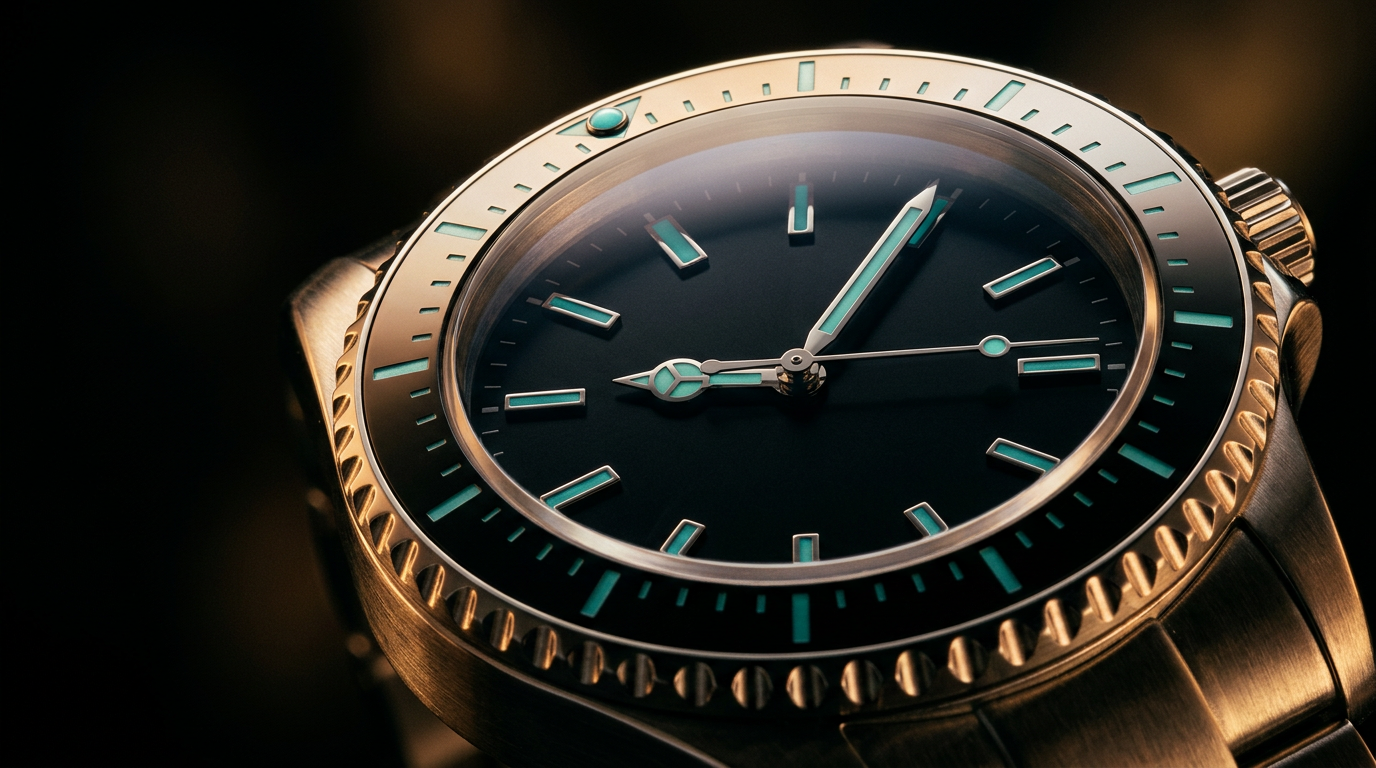
Few debates in modern collecting reveal a buyer's philosophy as quickly as the choice between a core-collection Rolex and a core-collection Panerai. Both houses build serious tool-derived watches at the upper tier of Swiss production; both are unmistakable across a boardroom or a dive deck. What separates them is not quality — it is intent. Rolex has spent a century sharpening universal legibility, precision, and understated presence. Panerai has spent decades translating a mid-century Italian military instrument into a design language that rewards deliberate, expressive wearing.
This guide compares the two houses at the level a discerning buyer actually decides: how the watches wear, how they read on the wrist across a real wardrobe, what the movements and cases have been engineered to prioritise, and where each is stronger. It is drawn from officially published Rolex and Panerai reference material and from direct experience placing both brands with collectors.
Two Different Answers to the Same Question
Every serious wristwatch is an answer to a question: what should a single object on the wrist communicate? Rolex's answer, refined since the 1930s, has been restraint married to obvious competence. Its Oyster case, chronometer movements and integrated bracelets are engineered around universal legibility and long-term wearability. A Datejust or Submariner is designed to disappear into a suit cuff on Monday and read cleanly on a boat by Friday.
Panerai's answer, refined from its 1930s and 1940s Italian Navy instruments, has been presence over subtlety. The cushion case, sandwich-style dial architecture, and pronounced crown-protection bridge exist because these watches were originally made to be read at a glance underwater, in low light, by frogmen. The modern collection preserves that visual DNA and marries it to genuine haute-horlogerie in-house calibres that can run three or more days off a full wind.
The Rolex Case for a Discerning Buyer
The strongest single argument for Rolex is range. A well-chosen Rolex from the core collection — Datejust, Submariner, Explorer, GMT-Master II — can be the only wristwatch a professional wears for a decade and never feel wrong for the occasion. Two structural reasons drive that:
- Deliberate case sizing. The core references live in the 36 mm–41 mm window, with balanced lug lengths and low profiles that suit the widest possible range of wrists and cuffs.
- Precision as a promise, not a claim. The current in-house Rolex calibres — including the 3230 (Submariner No-Date) and 3235 (Datejust 41, Submariner Date) — are specified by Rolex to run within −2 / +2 seconds per day after casing, tested at Rolex's own Superlative Chronometer standard, above the standard COSC baseline of −4/+6.
A Datejust 41 in Oystersteel with a fluted white-gold bezel and a Jubilee bracelet remains the strongest single-watch answer for a collector who wants to signal considered, not conspicuous. A Submariner Date in ceramic and steel is the purest tool-luxury proposition on the market: bulletproof to 300 m, quiet in a boardroom, iconic on a boat.
The Panerai Case for a Discerning Buyer
The strongest single argument for Panerai is character. A Luminor Marina or a Submersible is instantly recognisable across a room, and its identity rests on architecture, not decoration. The cushion case, the massive crown-protection bridge on the Luminor family, and the layered sandwich dial (a luminous under-plate showing through cut-out numerals and indices) are engineering decisions transferred from a mid-century military instrument to a modern haute-horlogerie object.
On the movement side, the Panerai P.900-series and P.9010/P.9100 in-house calibres pair a three-day power reserve with a hacking-seconds function, and the higher-tier P.4000 automatics use a micro-rotor to keep case profiles remarkably slim for cases of 44 mm and above. The reference we routinely place with new Panerai clients — the Luminor Marina 44 mm (PAM01312), powered by the automatic P.9010 — is COSC-certified and matches a three-day reserve to Panerai's classical dial.
Panerai's other virtue is its strap ecosystem. Because the case is the identity, the strap becomes the wardrobe. A single reference lives comfortably on vintage-style calf, alligator, textile or rubber, without ever looking styled. That is a very different ownership rhythm from a Rolex, whose integrated bracelet is deliberately part of the watch.
Head-to-Head: The Reference Matrix
The four references below are the ones a serious buyer will actually cross-shop. Values are drawn from each manufacturer's current published specifications for the core-collection variants at the time of writing; individual variants may differ.
| Attribute | Rolex Datejust 41 | Rolex Submariner Date | Panerai Luminor Marina | Panerai Submersible |
|---|---|---|---|---|
| Reference (typical) | 126334 | 126610LN | PAM01312 | PAM02973 |
| Case size | 41 mm | 41 mm | 44 mm cushion | 42 mm cushion |
| Case material | Oystersteel & white gold | Oystersteel | Steel | Steel |
| Water resistance | 100 m | 300 m | 300 m | 300 m |
| Movement | Cal. 3235 automatic | Cal. 3235 automatic | P.9010 automatic | P.900 automatic |
| Power reserve | ~70 hours | ~70 hours | 3 days (72 h) | 3 days (72 h) |
| Accuracy specification | Superlative Chronometer −2/+2 sec/day | Superlative Chronometer −2/+2 sec/day | COSC-certified, six-position tested | Six-position tested (in-house) |
| Strap / bracelet | Oyster or Jubilee bracelet | Oyster bracelet | Interchangeable straps | Rubber or steel bracelet |
| Best worn as | All-occasion dress-tool | Tool-luxury one-watch | Statement daily | Expressive sports watch |
How Each Wears on the Wrist
A round 41 mm Rolex Oyster case sits close to the wrist, with lug-to-lug dimensions that read comfortably on wrists from roughly 6.5 to 8 inches. The bracelet is part of the design; the watch is essentially seamless.
A 44 mm Panerai cushion case reads a full size or more larger than a 44 mm round. Its identity depends on being seen. On a 7.5-inch wrist it is a considered, confident object; on a 6.5-inch wrist it becomes decorative rather than functional. Try before you buy — this is not a specification-sheet decision.
Investment Considerations
Both brands protect value better than the wider Swiss watch industry, but they behave differently in the pre-owned market. Modern steel-sports Rolex references retain broad, deep demand across geographies — the market for a Submariner Date in most conditions is measured in days, not months. Panerai's collector market is narrower and more design-literate: values are strongest on the historically important limited editions and the reference variants that stayed truest to the original 1940s proportions.
For most private clients, Rolex is the stronger liquidity story; Panerai is the stronger design-appreciation story. Neither should be bought as an investment — they should be bought to be worn.
The Collector's Short Answer
Choose Rolex when the watch must move effortlessly across meetings, travel, black tie and weekend wear, and when quiet universal recognition matters more than statement.
Choose Panerai when the wristwatch is meant to be a considered piece of the outfit — when presence, cushion-case architecture, and the ritual of a strap wardrobe are part of why you're wearing it.
Sophisticated collectors ultimately end up with both. They serve different moments — and neither can do the other's job.
Continue Reading
If you are working toward acquisition, our Luxury Watch Authentication Guide sets the standard we recommend for every pre-owned purchase, and our practical inspection guide for Rolex is the closest thing to a working buyer's checklist we can publish.
Sources. Rolex — Superlative Chronometer specification and the Oyster Perpetual Datejust 41 and Submariner Date reference pages at rolex.com. Panerai — the Luminor Marina and Submersible reference pages, and the P.9010 / P.900 calibre specifications at panerai.com. All specifications reflect published core-collection variants at the time of writing; individual references may vary. This article is editorial guidance from Timepiece Opulence LSP and is not affiliated with, endorsed by, or produced in cooperation with Rolex or Panerai.