Counterfeit Rolex production has evolved from crude replicas into convincingly assembled objects that survive casual inspection. This guide walks through the categories a specialist actually looks at during intake — model plausibility, case and engraving evidence, dial architecture, bracelet and clasp, documentation, seller behavior and payment structure — and explains why no single test decides the outcome. Nothing here is a counterfeit-production manual; a layperson cannot definitively authenticate a modern Rolex, and this guide does not claim to teach that. What a careful buyer can do is recognize the red flags that warrant stopping the transaction and routing the watch to an independent third-party specialist.
1. Start With Model and Reference Plausibility
Before looking at the watch, verify that the model, reference number, dial, bezel, bracelet and case material combination Rolex actually produced in the claimed year. Rolex publishes the current catalog on rolex.com; discontinued references are documented in reputable reference works and auction archives. A "1970s stainless-steel Daytona with a ceramic bezel" or a "GMT-Master II ref. 116710 with a Jubilee bracelet" is a specification that never left the manufacture. Configuration implausibility is the single most efficient filter — it costs nothing and eliminates a large share of counterfeits before the watch is even picked up.
2. Case Back Conventions and Exceptions
Modern Rolex sports and dress watches ship with a plain, unengraved, pressure-fit case back — no logos, no display window, no external engravings advertising the movement. Common counterfeits carry etched coronets, model names or "genuine Rolex" text on the case back, or a transparent case back showing an off-the-shelf automatic movement. Both are inconsistent with modern Rolex production. There are documented exceptions in vintage references (some Sea-Dwellers engraved on the exterior, certain commemorative case backs and boutique/customer engravings), so plain vs. engraved is a signal, not a verdict. What a specialist looks at is whether the specific case back is consistent with the reference, year and production convention.
3. Engravings and the Rehaut
On modern references (roughly post-2005), Rolex laser-engraves a repeating "ROLEXROLEXROLEX" pattern into the rehaut — the inner flange between the dial and the crystal — with the case serial number engraved between six o'clock. The engraving is precise, evenly spaced and clean-edged; the depth is shallow but consistent. Counterfeit rehaut engravings tend to show inconsistent spacing, uneven depth, aliased character edges, or a serial number that visually "floats" above the rehaut surface. Between the lugs, the case is engraved with the reference number (12 o'clock side) and, on many watches, a serial number (6 o'clock side) on earlier references. Engraving evidence is a strong category — but it requires magnification, a loupe, and a reference example for comparison. It is not a curbside test.
4. Cyclops, Date Wheel — and Why Magnification Alone Is Not Decisive
Rolex specifies its cyclops lens at approximately 2.5× magnification; the date should fill the lens and align precisely with the aperture. Many counterfeits use lower-magnification lenses (1.5×–2×) or misaligned date wheels. Font weight, kerning and character shape on the date wheel are also frequent tells. However, the cyclops test on its own has become unreliable — recent counterfeits reproduce 2.5× magnification convincingly. Use the cyclops as one input, not as a verdict.
5. Dial: Coronet, Text, Lume, Hands
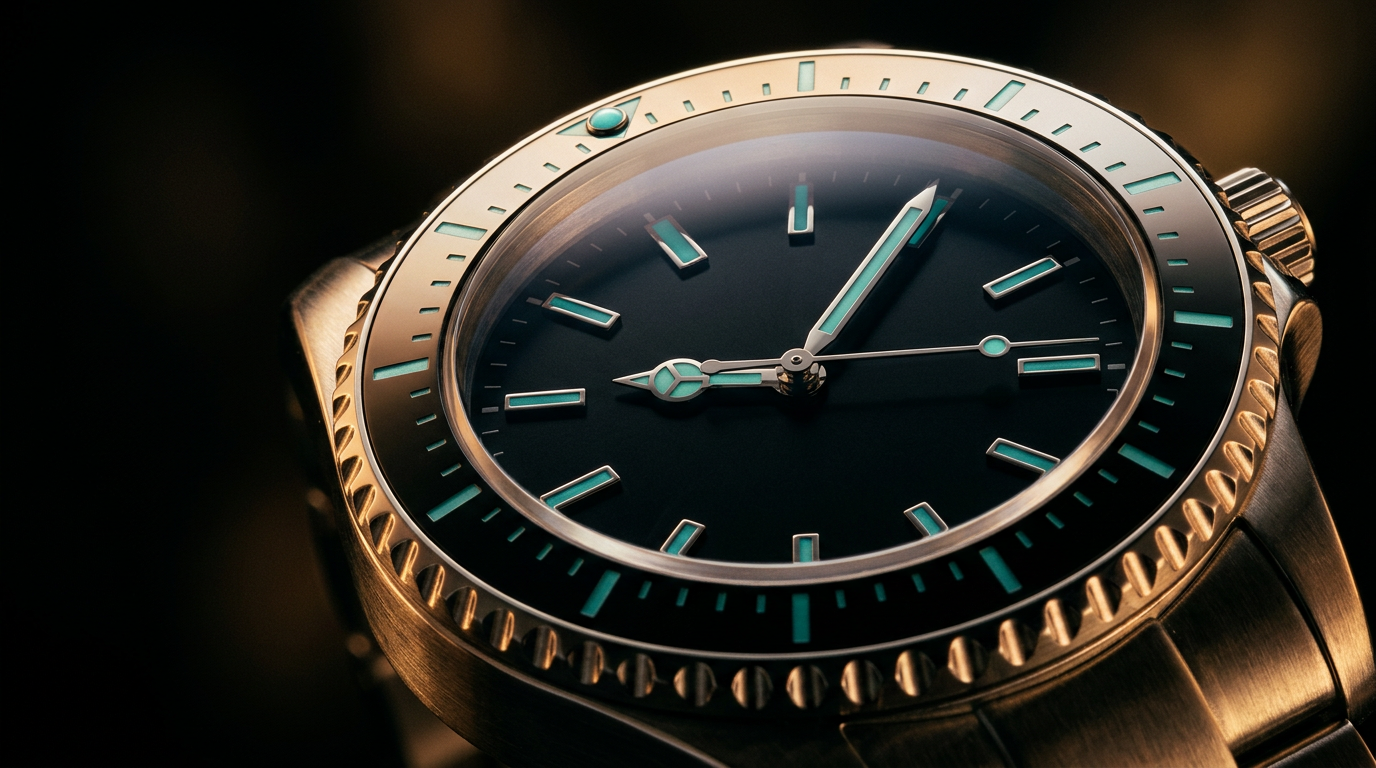
The applied coronet, printed text, indices, lume plots and hands are the highest-signal single area on a Rolex dial:
- Coronet. The applied crown on modern dials is a precise, three-dimensional casting with clean corners on each of the five points and a symmetrical base. Poorly cast coronets show rounded points, uneven surfaces or misalignment relative to the twelve marker.
- Text. Print is razor-sharp under 10× magnification, with consistent line weight and no visible pixelation or bleed. Font choices are era-specific; a font that is "close" is a red flag.
- Lume plots. Applied lume on modern dials is even, domed and consistently sized across all plots. Uneven fill, chalky surfaces or asymmetric plot geometry are signals.
- Hands. Rolex hand geometry is reference-specific. Substituted or aftermarket hands show incorrect proportions or lume fill that does not match the dial plots.
6. Bezel, Crown and Case Finishing
Modern Rolex ceramic bezels (Cerachrom) have crisp, laser-etched and platinum- or gold-filled numerals with clean edges. Aluminum vintage bezels have their own conventions. A bezel that rotates with the wrong click count (most sports bezels are 120-click unidirectional; GMT rotating bezels are 24-click bidirectional on modern references) warrants attention. The winding crown is triple-signed on modern references, with clean coronet detail and correct thread engagement. Case finishing on Rolex is machine-consistent: polished surfaces are flat and even, brushed surfaces have straight parallel grain, transitions between finishes are sharp. Rounded transitions, wavy polish or inconsistent brushing on a "new" watch is a red flag.
7. Bracelet, Clasp and End Links
Modern Rolex Oyster and Jubilee bracelets are solid-link with laser- etched coronets inside the clasp and, on many references, on the inner clasp cover. End links fit the case without gaps and follow the case curvature. Clasp mechanisms (Oysterclasp, Glidelock, Easylink) operate with a precise, damped action. Rattly bracelets, hollow end links on a reference that should have solid ones, and coronet engravings that are soft or missing on the clasp are meaningful signals.
8. Weight — a Clue, Not a Test
Counterfeit forums often quote "grams" as if weight authenticates a Rolex. It does not. Modern counterfeits routinely match genuine weight within a few grams, and small variance between production years exists on the genuine side. Weight is a coarse sanity check, not a decisive test.
9. Movement Sound Myths
"Real Rolex ticks smoothly, fake Rolex tick-tick-ticks" is a myth. All mechanical watches with sweeping seconds — genuine or counterfeit — beat several times per second; a smooth-looking sweep only means the movement is mechanical. Some higher-end counterfeits now use decorated clones of ETA/Sellita automatic movements that sweep and sound the same as a genuine caliber to an untrained ear. Movement sound is not an authentication signal.
10. Professional Caliber Inspection
The single strongest evidence category is the movement itself, viewed by a qualified watchmaker with the case back removed. Rolex in-house calibers have specific architecture, finishing, rotor geometry, balance construction, jewel counts and engravings. A caliber inspection catches counterfeits that pass every external check, because the underlying movement is a modified ETA/Sellita or an unmarked Chinese clone. This step requires a specialist. Do not attempt to remove a Rolex case back with common tools; you will damage the watch and, potentially, void any recourse against the seller.
11. Serial, Reference and Their Limits
Serial numbers are useful for dating a reference and for stolen-watch database lookups — but a matching, plausible serial does not prove authenticity. Serials are trivially reproduced on counterfeit cases. Rolex does not operate a public serial-verification portal, and any third-party "serial checker" claiming to confirm authenticity from a number alone is unreliable. Use the serial to date the watch against published production ranges and to run a stolen-watch check; do not use it as a standalone authenticity signal.
12. Warranty Card, Booklet and Papers
The warranty card should name a specific authorized dealer, carry a matching case serial, and reflect current Rolex card design for its year. Modern cards are credit-card format with security features; earlier cards were paper. Counterfeit cards are common and can be convincing — the presence of a card does not authenticate a watch. The useful test is consistency: does the card format match the year, does the dealer name resolve to a real authorized retailer, does the case serial match, and does the card show wear patterns consistent with the claimed provenance? A pristine "1998" card is a signal, not proof of anything on its own.
13. Seller, Price and Payment Red Flags
Non-technical signals matter as much as case-back engravings:
- Price meaningfully below the observable secondary market for the reference and condition.
- Refusal to allow independent third-party authentication before release of funds.
- Insistence on wire transfer to a personal account, or payment methods that eliminate recourse.
- Refusal or inability to produce the seller's identity documents for AML/KYC verification.
- "Meet in a parking lot" transactions with no paper trail.
- Time pressure — "I need to sell today" or "another buyer is on the way" — used to bypass inspection.
- Photography that never shows the case back, movement, clasp engraving or serial between the lugs.
14. Stolen-Watch Checks and Title
Run the case serial number through a private register such as The Watch Register before completing the transaction. A hit does not automatically prove the current seller is complicit, but it warrants stopping and involving qualified counsel. Verify the seller is the watch's current registered owner and that no lien, estate or dispute is outstanding on the piece.
Myth vs. Evidence
| Common Myth | What the Evidence Actually Shows |
|---|---|
| "Real Rolex has a smooth sweep." | All mechanical watches sweep; a sweep only proves the movement is mechanical. |
| "Real Rolex weighs X grams." | Modern counterfeits match genuine weight within a few grams. |
| "The cyclops 2.5× test is decisive." | Recent counterfeits reproduce 2.5× magnification convincingly. |
| "A serial number matching the year proves authenticity." | Serials are trivially reproduced; serial only supports dating and stolen-watch checks. |
| "Presence of a warranty card authenticates the watch." | Counterfeit cards are common; card supports, does not prove. |
| "I can authenticate it myself with a loupe and YouTube." | External evidence is a filter; caliber inspection by a qualified watchmaker is the decisive step. |
What to Do Before Release of Funds
- Verify configuration plausibility against manufacturer and reference sources.
- Photograph and record reference, serial and clasp code.
- Run a stolen-watch database check.
- Route the watch through a qualified independent third-party specialist for physical authentication, including caliber inspection.
- Fund via neutral bonded escrow; release only after independent authentication and buyer sign-off.
- Keep the full transaction file — photos, authentication report, escrow records, sale agreement — indefinitely.
Where Independent Authentication Fits
Independent third-party authentication materially reduces the buyer's evidentiary burden by moving the decision from the seller's word to a qualified specialist's written examination. It does not, and cannot, promise zero risk — authentication is an evidence-based conclusion at a moment in time. Timepiece Opulence LSP is an independent private brokerage; every watch we place is required to undergo independent third-party authentication before it is offered to a client. We are not affiliated with, endorsed by or an authorized dealer of Rolex or any other manufacturer.
Continue Reading
For the full authentication process across brands, see the luxury watch authentication guide. For Patek Philippe specifics, see How to Verify a Genuine Patek Philippe. For documentation standards, see Pre-Owned Luxury Watch Documents.
Sources
- Rolex — current collection and technical specifications: rolex.com.
- The Watch Register — stolen-watch database: thewatchregister.com.
- Christie's Watches department reference archive: christies.com.
- US FinCEN AML/KYC guidance for high-value goods: fincen.gov.
Editorial disclosure. Timepiece Opulence LSP is an independent private brokerage. We are not affiliated with, endorsed by, or an authorized dealer of Rolex or any manufacturer discussed. This is editorial guidance, not legal advice or an authentication opinion on a specific watch. No inspection process can guarantee zero risk. Buyers should obtain qualified independent third-party authentication before release of funds. Observations reflect publicly available sources as of July 21, 2026.