
Authenticating a Patek Philippe is a different exercise from authenticating a Rolex. Patek's production is smaller, its finishing conventions are haute-horlogerie rather than industrial, its dial and case detailing carry more variation across eras, and its documentation infrastructure — the Certificate of Origin at retail and the Extract from the Archives on request — creates a paper trail that does not exist at any other major house. This guide walks through the evidentiary categories a specialist relies on, explains what each piece of documentation actually proves (and does not prove), and sets out an evidence hierarchy for a defensible authentication decision. Nothing here is a substitute for physical examination by a qualified watchmaker. Observations reflect publicly available sources as of July 21, 2026.
1. Reference, Case and Movement Numbers
Every Patek Philippe carries three primary identifiers:
- Reference number — engraved between the lugs on modern references, identifying the model, case material and configuration.
- Case serial number — engraved on the case, typically between the lugs, uniquely identifying the individual watch.
- Movement serial number — engraved on the movement, typically on a bridge, accessible only with the case back removed by a qualified watchmaker.
A defensible authentication verifies all three, cross-checks them against Patek's own records via an Extract from the Archives, and confirms consistency with the year, reference and configuration claimed. Any single mismatch — a case serial that does not correspond to the reference's production window, a movement number that does not match archive records for that case — is a stop signal.
2. Caliber Architecture
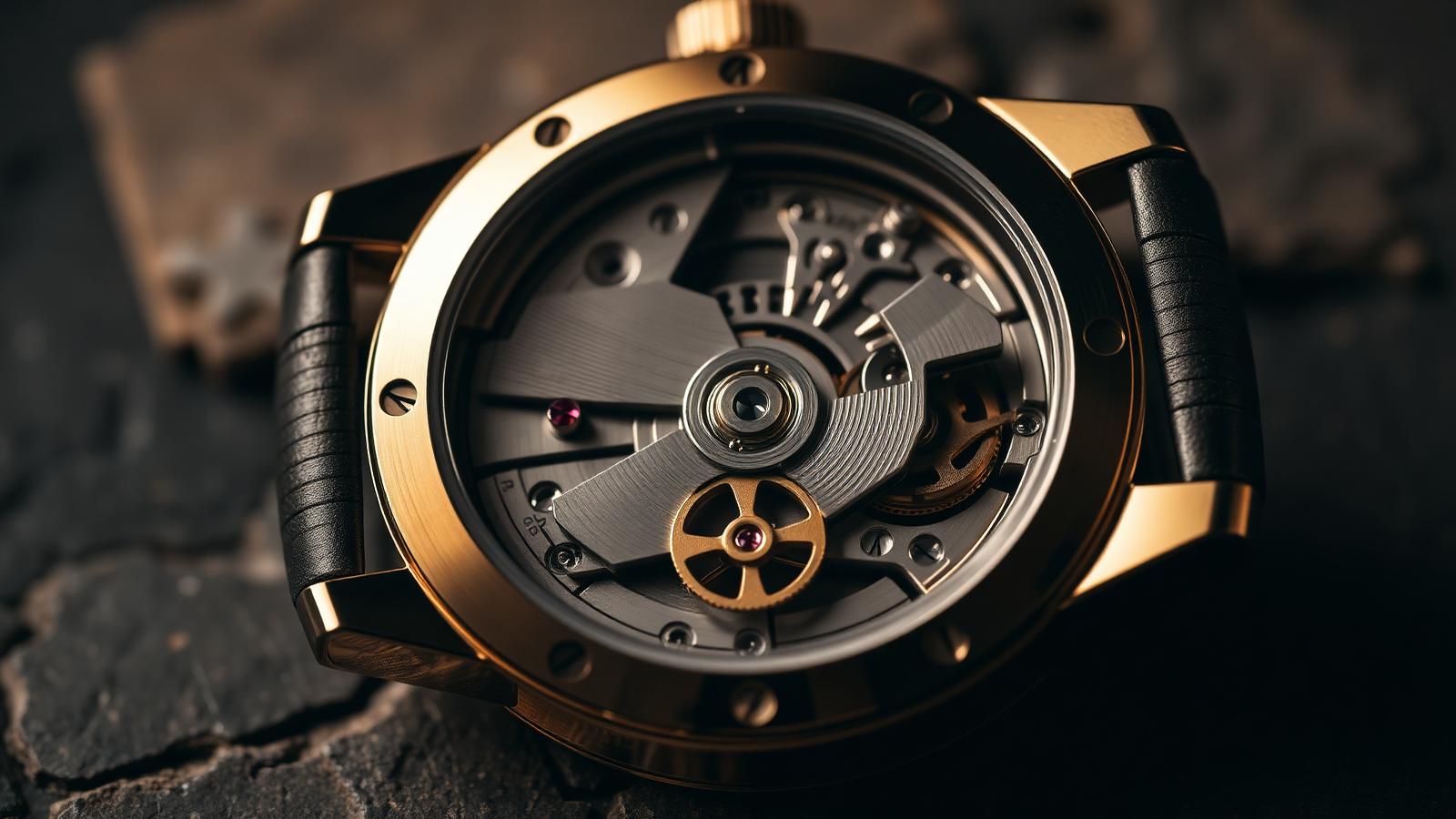
Patek movements have specific architecture per caliber family — bridge layout, jewel count, escapement design, winding-mechanism geometry, rotor decoration and construction. A specialist compares the movement against a reference example of the correct caliber for the reference and year. Substituted movements from a lower-tier caliber or from an aftermarket clone are the primary counterfeit vector at this level; external cosmetic clones can be convincing, but the movement is difficult to reproduce faithfully at Patek's finishing standard.
3. Movement Finishing and Hallmarks by Era
Patek's finishing is the strongest single evidence category:
- Bridge chamfers (anglage) are hand-polished at a defined width with mirror-bright edges — machine-finished chamfers are visibly different at 10× magnification.
- Perlage on the mainplate is uniform in circle size and overlap pattern.
- Côtes de Genève striping on bridges shows consistent line spacing and depth.
- Screw heads are polished, chamfered and slot-aligned — not machine-finished stock.
- Hallmarks: the Geneva Seal (Poinçon de Genève) on pre-2009 production, and the Patek Philippe Seal (Poinçon Patek Philippe) from 2009 forward, are applied to specific components and follow era-specific conventions. Presence, placement and typography must be consistent with the reference and year.
4. Dial: Typography, Signatures, Indices, Hands
Patek dial print is executed to haute-horlogerie standards: line weight is consistent, characters are sharply defined under 10× magnification, and the applied Patek Philippe signature is a three-dimensional element with clean edges and correct proportion for the reference. Applied indices are set precisely at the correct radial position; hand geometry matches published references for the caliber and dial. Repainted or restored dials are common on vintage Patek and are not automatically disqualifying, but they must be disclosed in writing and priced accordingly. An undisclosed redial is one of the most consequential value questions on a vintage Patek — a specialist will call it out; a casual seller often will not.
5. Case: Proportions, Polishing and Hallmarks
Case proportions are reference-specific. Patek cases are typically crafted by specialist case-makers to the manufacture's standards, with precise lug thickness, bevel geometry and chamfer definition. Over- polishing on vintage cases is a widespread problem: it rounds off the chamfers, softens lug edges and reduces case weight. Independent assessment of case originality is a distinct examination step. Case hallmarks — Swiss standard hallmarks for precious-metal cases, plus the case-maker's mark — are applied in specific locations and follow era conventions.
6. Bracelet and Clasp
For references with integrated or Patek-supplied bracelets (Nautilus, Aquanaut, Golden Ellipse and certain dress lines), bracelet construction, clasp architecture and integration at the case are reference-specific. Aftermarket bracelets, reissued clasps or replacement links are common on older watches and must be disclosed. The Patek signature on the clasp, clasp mechanism and end-link fit are all inspection points.
7. Complications
A meaningful share of Patek production carries complications — perpetual calendars, annual calendars, chronographs, minute repeaters, world time, split-seconds. Each complication has reference-specific movement architecture and dial layout, and each is an additional authentication surface. Substituted or non-functional complications must be identified in writing; a perpetual calendar that misindexes at month end, or a chronograph reset that overshoots, is not "close to authentic" — it is a movement condition that materially affects value and requires disclosure.
8. Documentation: Certificate of Origin vs. Extract from the Archives
Two documents matter, and they answer different questions:
- Certificate of Origin. The original document issued at retail sale by an authorized Patek Philippe retailer. It names the buyer, the retailer, the sale date, the reference and the case serial. On modern watches this is a credit-card-format certificate; on earlier watches it is paper. It travels with the watch and is a primary provenance document.
- Extract from the Archives. A document Patek issues on request from Geneva, confirming that a specific movement number corresponds to a specific case and reference, sold on a specific date to a specific retailer (buyer name is not disclosed in a standard Extract). An Extract is applied for through Patek directly. It is a historical record, and this is the critical distinction: an Extract confirms what left Geneva under that movement number. It is not automatic proof that the physical watch submitted for authentication is the watch Patek made and shipped. A physical watch with a case, movement and dial substituted after the fact can still produce a genuine-looking Extract for the original movement number. The Extract is a strong evidence document; it is not the whole examination.
9. Service Records
Service records — invoices from Patek Philippe's own service network or a recognized independent — document the physical watch over time. A continuous service history, especially through Patek in Geneva or an authorized service center, is strong evidence of ongoing owner care and provides intermediate physical checkpoints on the watch's identity. Gaps in service history are not disqualifying, but they widen the range of unknowns and warrant additional physical examination.
10. Provenance and Stolen-Watch Checks
Provenance — how the watch traveled from the retailer of record to the current seller — is documented through the Certificate of Origin, subsequent sales invoices, insurance appraisals and prior catalogue records if the watch has been offered at auction. Run the case serial through a private register such as The Watch Register. Provenance and title checks are non-negotiable at meaningful value.
11. Manufacturer or Recognized Expert Examination
For material acquisitions, the strongest single step is examination by Patek Philippe's own service center or by a widely recognized independent specialist. Patek can examine and, where appropriate, confirm the watch's identity against its records with the physical piece in hand. This service is not free, not immediate, and not available in every jurisdiction, but at material value it is often the correct standard.
Evidence Hierarchy
| Weight | Evidence Category | What It Proves / What It Does Not |
|---|---|---|
| Highest | Manufacturer physical examination (Patek Geneva or authorized service center) | Physical identity against Patek's records; not universally available on demand. |
| High | Recognized independent specialist physical exam (case, movement, dial, complications) | Consistency of the physical watch with the reference, year and archive data. |
| High | Extract from the Archives, cross-checked against the physical watch | What left Geneva under that movement number; not automatic proof the current physical watch is that watch. |
| Medium-High | Original Certificate of Origin with matching case serial | Retail sale record; supports provenance, does not authenticate alone. |
| Medium | Patek service invoices with matching case serial | Ongoing physical checkpoints; strengthens the chain of custody. |
| Medium | Prior auction catalogue with images and description of the specific watch | Public record of the piece at a defined point in time. |
| Supporting | Serial number lookup on a public reference site | Directional dating only; not a verification of authenticity. |
What an Extract Does Not Do
The single most important point in this guide: an Extract from the Archives is a historical record. It confirms what Patek shipped under a specific movement number to a specific retailer on a specific date. It does not confirm that the physical watch you are looking at today is that shipped watch. Cases, dials and movements can be substituted after the fact and still produce a valid Extract for the original movement number. That is why the Extract sits in the evidence hierarchy alongside — not instead of — a specialist physical examination.
What to Do Before Release of Funds
- Verify reference, case and movement serials against the Extract from the Archives.
- Route the watch through a recognized independent specialist for physical examination — case, movement, dial, complications.
- For material value, submit to Patek Philippe's service center for identity confirmation where available.
- Verify Certificate of Origin, service invoices and prior catalogue records match the physical watch.
- Run a stolen-watch database check and confirm title with the current seller.
- Fund via neutral bonded escrow; release only after independent authentication and buyer sign-off.
Where Independent Authentication Fits
Independent third-party authentication reduces the buyer's evidentiary burden by moving the decision from the seller's word to a qualified specialist's written examination. It does not, and cannot, promise zero risk. Timepiece Opulence LSP is an independent private brokerage; every Patek Philippe we place is required to undergo independent third-party authentication, including provenance review, before it is offered to a client. We are not affiliated with, endorsed by, or an authorized dealer of Patek Philippe.
Continue Reading
For the general authentication process, see the luxury watch authentication guide. For Rolex-specific counterfeit signals, see How to Spot a Counterfeit Rolex. For the documentation standard, see Pre-Owned Luxury Watch Documents.
Sources
- Patek Philippe — Extract from the Archives service: patek.com/en/services/certificates.
- Patek Philippe Seal — official reference: patek.com/en/company/patek-philippe-seal.
- Poinçon de Genève (Geneva Seal) — official reference: poincondegeneve.ch.
- The Watch Register — stolen-watch database: thewatchregister.com.
- Christie's Watches department: christies.com.
Editorial disclosure. Timepiece Opulence LSP is an independent private brokerage. We are not affiliated with, endorsed by, or an authorized dealer of Patek Philippe. This is editorial guidance, not legal advice or an authentication opinion on a specific watch. No authentication process can guarantee zero risk. Buyers should obtain qualified independent third-party authentication, and where warranted, manufacturer examination, before release of funds. Observations reflect publicly available sources as of July 21, 2026.