
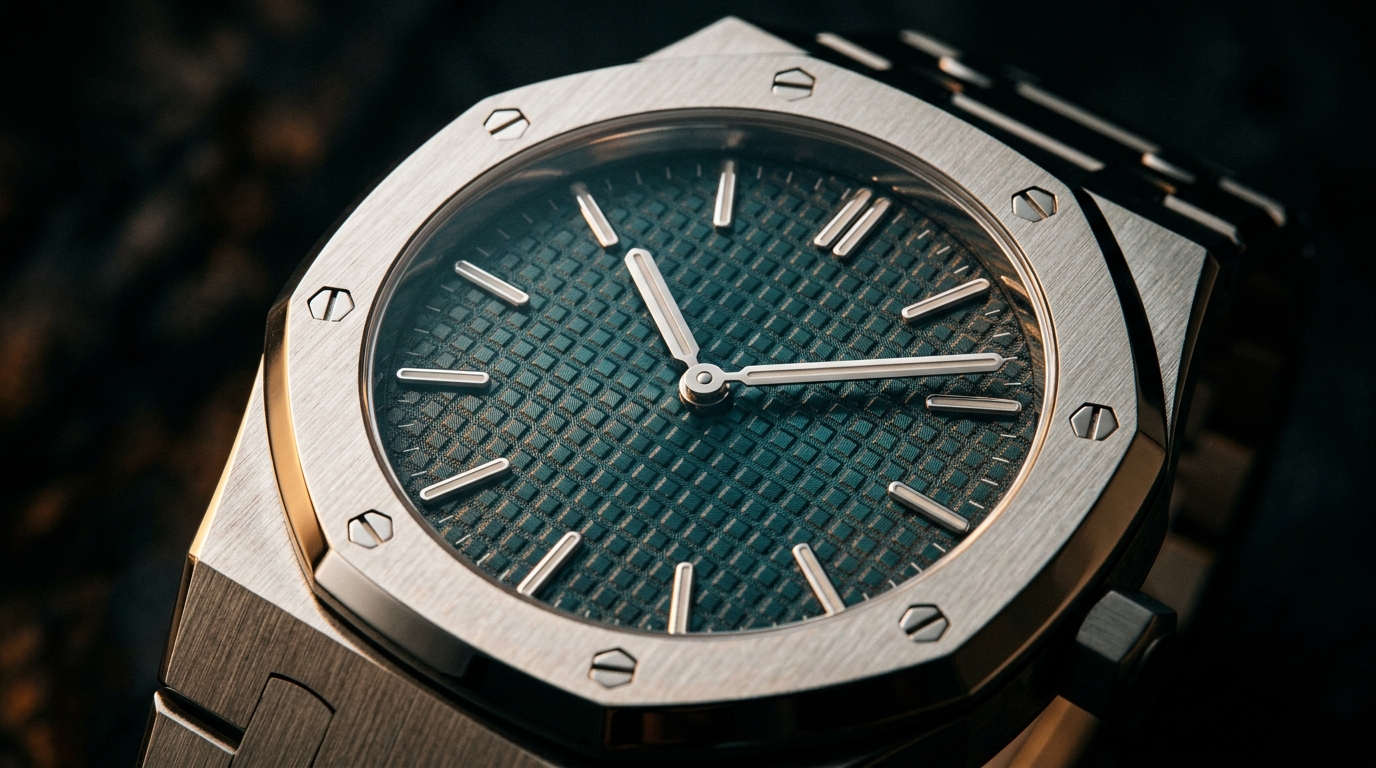
A serious buyer approaches a Royal Oak acquisition with a clear understanding of why the direct authorised-retail route is often not available on the highest-demand references. Audemars Piguet allocates production against long-standing client relationships; a first-time buyer without documented history rarely receives an allocation of a 16202ST, a Royal Oak Chronograph in a coveted configuration, or a precious-metal Jumbo Extra-Thin in the short term. That is not a hidden queue that can be paid past; it is a stated commercial reality of a manufacture whose production capacity is a small fraction of demand.
This guide is a practical framework for acquiring a Royal Oak outside the authorised-retail channel — how the alternative channels differ, what each rewards and what each risks, and the process a specialist runs from mandate to insured delivery. Observations reflect the practices of the pre-owned market as of July 21, 2026.
The Off-Market Channels
- Collector-to-collector private sale. The narrowest and, when executed well, often the highest-quality channel. Requires trust, documentation and — for anything above nominal value — third-party authentication and escrow.
- Vetted private broker. A specialist practice representing the buyer, sourcing candidates across the market, running written comparables and authentication, and executing under a defined mandate.
- Secondary dealer. Inventory-holding dealer with public offerings. Faster; typically wider ask over completed-sale market.
- Consignment. A private seller listing through a dealer or consignment platform. Buyer bears the same authentication burden as private sale.
- Auction. Christie's, Sotheby's, Phillips, Antiquorum, Bonhams. Public, catalogued, competitive. Buyer's premium (typically 26–27% in 2026) on top of hammer.
Channel Comparison
| Channel | Typical Spread | Speed | Buyer Effort |
|---|---|---|---|
| Private collector-to-collector | Narrow | Slow | Very high |
| Vetted broker | Narrow to moderate | Moderate | Low (delegated) |
| Secondary dealer | Wider (inventory margin) | Fast | Moderate |
| Consignment platform | Moderate | Fast | High |
| Auction | Buyer's premium (~26–27%) | Scheduled cycle | Moderate |
Step 1 — Written Mandate and Specification
Before a single conversation with a seller, the buyer's specification is written down: reference, generation, material suffix, dial tone, size, acceptable configuration variants, required documentation (full set, papers-only, watch-only with archive extract), acceptable condition tier, target all-in cost basis, and walk-away price. This document is what a specialist works to. Without it, anything the market offers can look attractive on a given day.
Step 2 — Proof of Funds Where Appropriate
On higher-value acquisitions, sellers and private consignors reasonably expect a buyer to demonstrate readiness. A short letter from the buyer's bank or an escrow-agent readiness letter is standard, does not disclose sensitive detail, and opens doors that a general expression of interest does not.
Step 3 — Sourcing and Comparables
The specialist sources candidates across channels. For each candidate, a written comparable-market file is built: recent premium-inclusive auction totals for the same reference and configuration, current secondary-platform asking ranges, and the specialist's written adjustment applied to condition, completeness and provenance. Asking price is not treated as market price; completed premium-inclusive totals anchor the range.
Step 4 — Seller and Title Checks
Before authentication, the seller's standing is checked. On a private-party sale, the specialist verifies identity, standing (business or individual), and confirms the seller's title to the watch — that the seller is the current registered owner and that no lien, dispute or estate matter is outstanding. On a dealer sale, the dealer's history, refund policy and prior dispute record are reviewed.
Step 5 — Escrow and Payment
Payment structure on a private-party transaction typically routes through a neutral escrow — a bonded escrow service or a specialist attorney trust account. Wire funds do not release until the watch has been physically inspected by the buyer's specialist and authentication is complete. This is standard for transactions of any significant value and is a reasonable expectation of any counterparty; a seller who refuses escrow at a serious price point is a signal to walk.
Step 6 — Independent Physical Authentication
Every candidate at meaningful value routes through independent third-party physical authentication before funds release. Authentication is not the same as appraisal, service, or manufacturer certification; it is a structured examination of the case, dial, hands, movement, bracelet, documentation and stolen-watch database status. See the luxury watch authentication guide for the underlying standard.
Step 7 — Provenance and Document Review
Documentary review runs in parallel with physical authentication. Warranty card / Certificate of Origin, original sales invoice, service invoices, archive extract where offered, prior auction catalogue where applicable — the specialist verifies each against contemporaneous exemplars and against the physical watch. See Pre-Owned Luxury Watch Documents for the full checklist.
Step 8 — Written Condition Report
The specialist issues a written condition report covering case chamfer sharpness, bracelet stretch, dial originality, movement service history, timing performance on a timegrapher, water-resistance test result where applicable, and any aftermarket parts identified. The report describes findings in plain language and distinguishes documented facts from inferences.
Step 9 — Insured Logistics
Physical transfer is arranged through a specialist high-value courier or bonded watch-logistics carrier. Insurance is arranged before the watch is handed to the courier, with a defined declared value and named-insured schedule. Chain of custody is documented at every handover.
Step 10 — Post-Sale Support
After delivery, ongoing support covers insurance schedule updates, service window planning against the manufacturer's recommended interval, and a periodic market-context refresh so the client understands their position without needing to transact.
A Working Transaction Timeline
| Phase | Typical Window |
|---|---|
| Mandate, specification and readiness | Same week |
| Sourcing, comparables and shortlist | 1–6 weeks (reference-dependent) |
| Seller and title checks, escrow setup | 3–7 business days |
| Physical inspection, authentication, condition report | 3–10 business days |
| Funds release and insured logistics | 3–7 business days |
| Delivery and post-sale documentation | 1–2 business days after delivery |
Broker-Vetting Questions
- How long has the practice operated under its current legal entity?
- Who are the named partners; what is their public professional history?
- Is the practice an authorised dealer of any manufacturer? (An honest answer is often "no"; a claimed authorisation should be verifiable on the manufacturer's own website.)
- Is the practice acting for the buyer or the seller on this transaction? Is the compensation structure fully disclosed in writing?
- What written comparable-market data will accompany a candidate?
- What escrow or trust arrangement is proposed for payment?
- Who performs the independent physical authentication? (The broker should not authenticate their own inventory.)
- What is the written policy if authentication returns a negative result after deposit?
- What insured logistics carrier is used?
- What is the practice's stated policy on non-affiliation and on avoided conflict of interest?
Editorial Callout
A vetted private broker does not deliver a guaranteed allocation or a discounted watch. They deliver a defensible process — written comparables, neutral escrow, independent authentication and insured logistics — that reduces the friction and the risk of an off-market acquisition.
Where Timepiece Opulence LSP Fits
Timepiece Opulence LSP operates as a vetted private practice for Royal Oak acquisitions and placements. We source across channels under a written mandate, build written comparable-market files, use neutral escrow, route each candidate through independent third-party physical authentication, and manage insured logistics end to end. We do not represent that any specific reference will be available on a defined timeline, and we do not sell "waitlist positions" — a Royal Oak allocation is not, in fact, transferable.
Continue Reading
For the underlying value framework, see Royal Oak Value Guide. For the authentication and documentation standards, see the authentication guide and the document checklist.
Sources
- Audemars Piguet after-sales and boutique locator — audemarspiguet.com.
- Auction terms and buyer's premium — christies.com, sothebys.com, phillips.com.
- The Watch Register — thewatchregister.com.
Editorial disclosure. Timepiece Opulence LSP is an independent private brokerage. We are not affiliated with, endorsed by, or an authorized dealer of Audemars Piguet. Observations reflect publicly available sources as of July 21, 2026. No practice can guarantee allocation, availability or zero-risk acquisition of a specific reference.